Commercial roofs come in many different types. If you own a building, it can be hard to know which roof is best.
Four common options for flat roofs are EPDM, TPO, PVC, and Full Fabric (a roof restoration).
Each system has good and bad points. The best choice depends on your building, the condition of your roof, and how you use the building.
Here is a simple look at each option.
EPDM Roofing
EPDM is a rubber roofing system. It is often black and comes in large rolls.
The sheets of rubber are joined together with tape or glue. These seams cannot be welded together with heat.
EPDM has been used on commercial buildings for many years and can be a good roofing system when installed and cared for correctly.
One thing to watch is the seams.
As EPDM gets older, the rubber can shrink. This can put extra stress on seams, walls, corners, pipes, and other areas of the roof.
These areas should be checked during yearly roof inspections.
EPDM May Be a Good Choice When:
- The existing roof is still in good shape.
- The seams and flashings can be repaired.
- The building owner plans to inspect and maintain the roof.
TPO Roofing
TPO is another common commercial roofing system.
Unlike EPDM, TPO seams are joined together using heat. This is called heat welding.
Heat welding joins the sheets together and creates a strong, waterproof seam.
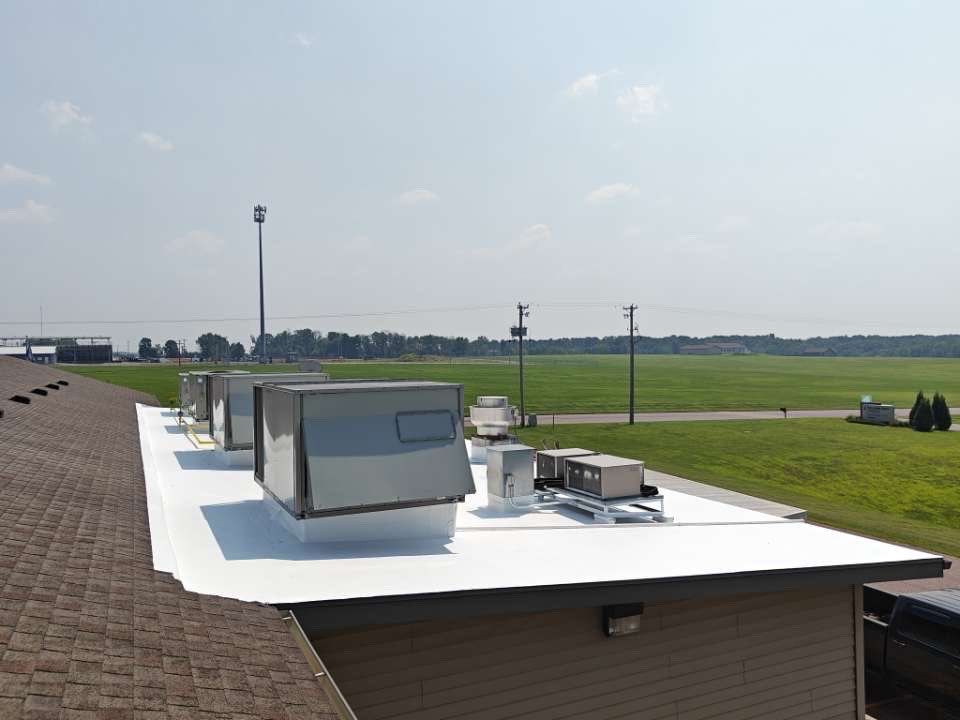
TPO is often white or light-colored. This helps reflect sunlight and can help keep the roof cooler during the summer.
TPO can be a good choice for many commercial buildings, but proper installation is very important.
If seams are not welded correctly, leaks can develop.
TPO can also be affected by some oils, grease, and chemicals. This is important for restaurants and some industrial buildings.
TPO May Be a Good Choice When:
- You need a new commercial roof.
- You want a white, reflective roof.
- The building does not have heavy grease, oil, or chemical exposure.
PVC Roofing
PVC is similar to TPO in several ways.
It comes in large sheets, and the seams are heat-welded together.
One major benefit of PVC is its resistance to grease, oils, animal fats, and many chemicals.
Because of this, PVC can be a good choice for restaurants, food plants, and some industrial buildings.
A properly installed PVC roof can provide a strong and watertight roofing system.
Like every commercial roof, PVC should still be inspected and maintained regularly.
PVC May Be a Good Choice When:
- The building has grease or oil on the roof.
- There is restaurant exhaust.
- The roof may be exposed to certain chemicals.
- You want a heat-welded roofing system.
Full Fabric Roof Restoration
A Full Fabric roof restoration is different from EPDM, TPO, and PVC.
Instead of covering the roof with large sheets of material, a liquid roofing system and strong fabric are installed over the existing roof.
A roof coating is sprayed and the fabric is placed into that coating. Another layer of base coating is then installed over it.
One of the biggest benefits is that there are no long seams between large rolls of roofing material – it is a strong, continuous roof surface.
The system can be installed around pipes, drains, walls, curbs, rooftop equipment, and other hard-to-seal areas.
In many cases, the existing roof can stay in place which helps save money, reduce waste, and cause less disruption to the business.
It is also a great option for new construction projects. During construction, it can initially be installed through the base coat phase (which waterproofs the roof while the remaining construction continues).
Then once the other trades—such as HVAC, electrical, and mechanical contractors—have completed their rooftop work, the final top coat can be applied.
This protects the finished roof from damage during construction and provides an advantage that many traditional membrane roofing systems do not offer.
Full Fabric Restoration May Be a Good Choice When:
- The existing roof is still strong and in good condition or it is a new construction.
- Most of the insulation is dry.
- The building owner wants to avoid a full roof tear-off.
- The owner wants to extend the life of the existing roof.
- A seamless, reinforced roof surface makes sense for the building.
Can Every Roof Be Restored?
No.
This is very important.
A roof restoration should not be used to cover up a bad roof.
Before restoring a roof, the existing roof should be inspected. Wet insulation, major roof damage, poor drainage, or structural problems may need to be fixed first.
Sometimes restoration is the best choice.
Other times, roof replacement is the better choice.
A good commercial roofing contractor should help you understand both options.
Which Roofing System Is Best?
There is no single roofing system that is best for every building.
EPDM can be a good system when it is properly installed and maintained as the rubber ages and shrinks.
TPO offers heat-welded seams and a reflective surface.
PVC offers heat-welded seams along with strong resistance to grease, oils, and many chemicals.
Full fabric restoration can give an existing roof a new, seamless, reinforced surface without tearing off the entire roof.
The most important step is finding out what your building actually needs.
At SR Commercial Roofing, we inspect the roof first. We look at the roof condition, moisture, drainage, seams, flashings, and other problem areas.
Then we can help you decide whether it makes more sense to repair, restore, or replace your commercial roof.
Not sure which option is right for your building? Contact SR Commercial Roofing on our website or at 608-844-4933 to schedule a roof inspection.